
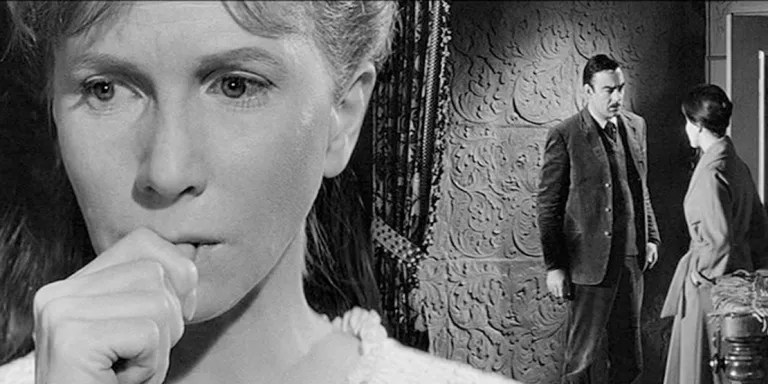
The Haunting (1963) could have failed, even though it’s based on a great novel (by Shirley Jackson), reimagined in a perfect script (by Nelson Gidding), and attracted a top director (Robert Wise) and a stellar cast (Julie Harris, Claire Bloom, Richard Johnson, and Russ Tamblyn), because talent alone doesn’t guarantee competence. But sometimes, somehow, a balance is achieved. However, that balance, as many have ruefully discovered, cannot be contained or explained.
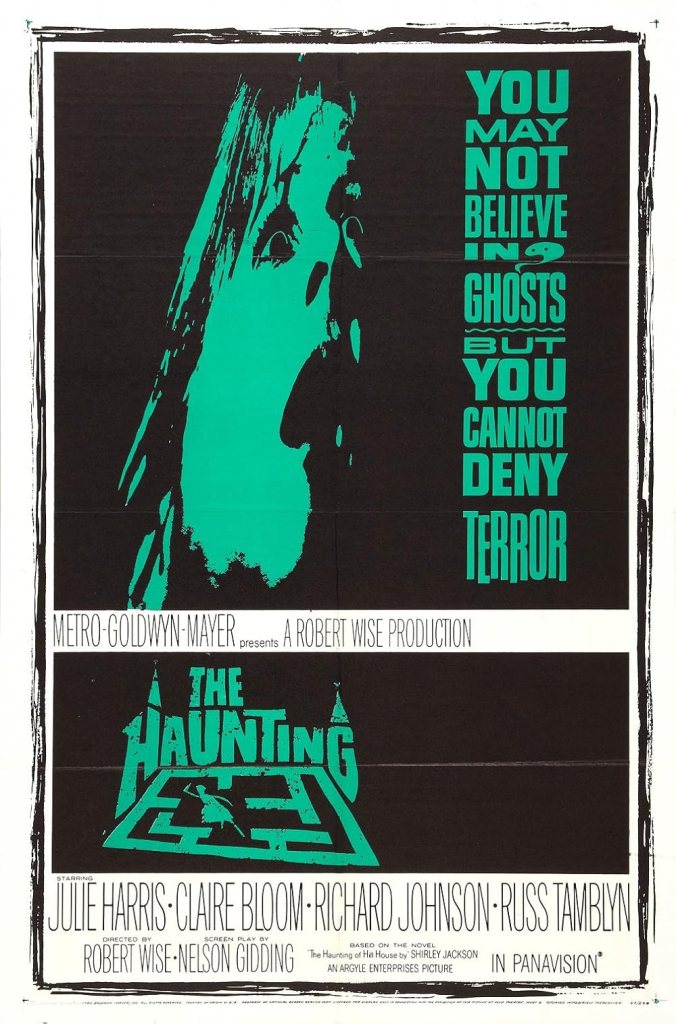
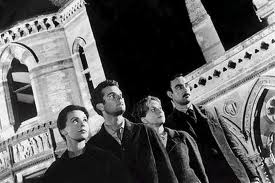
The film is about three people, invited by an academic who studies paranormal activity, to investigate a purportedly haunted house in New England. A voiceover, from the academic, gives us background on the house and its dark history. What endows this film with such power is the cinematic methods that force a viewer to discern which events derive from a character’s mental illness and those that belong in the realm of supernatural—if any.
Wise’s use of uneven camera angles, and a moody, atonal score by Humphrey Searle, further conflate the confusion. Each room has a ceiling, something rare (and claustrophobic) in films. This is a world without color, hence the choice of black and white film.
Eventually, and inevitably, a danse macabre begins between the fragile Eleanor (Julie Harris) and the house. She’s ambivalent about the place because it has given her, for once, a sense of purpose and importance. She experiences a sense of belonging and fights to remain on the property. Are there supernatural elements about or are we looking through Eleanor’s eyes? Is she responsible for the haunting?
The best horror and suspense films rarely offer answers, just intuitions. Hitchcock knew that. Perhaps the grave irony of The Haunting is that, like poor Eleanor, the house gets into our heads—at first subtle, but after that… it’s too late. The POV becomes you.
#thehaunting #film #review #robertwise #julieharris #clairebloom #1963 #letsplaysomethingelse #horror #suspense
 Let's Play Something Else